Le post Reddit qui a tout compris
« J'ai un fournisseur qui travaille dans une usine en Chine. Je fais appel à lui depuis 4 ans. Je le paie par PayPal. »
Ce commentaire sur r/Crystals tranche avec le brouhaha ambiant. Quatre ans. Même fournisseur. Aucune plateforme. Juste une relation fondée sur la confiance.
Comparez cela à l'acheteur moyen d'Alibaba : il parcourt des centaines d'annonces, compare des prix qui semblent tous identiques, et se demande qui est réellement une usine et qui est un intermédiaire.
Voici la réalité que la plupart des guides d'approvisionnement ne vous révéleront pas : Les frais de plateforme que vous ne voyez pas sont ceux qui vous coûtent le plus cher.
La commande de 3 000 $ : comparaison côte à côte
Prenons un exemple concret. Vous commandez 50 crânes en cristal de taille moyenne — un mélange d'améthyste, de quartz rose et de quartz clair. Le prix d'usine est de 40 $ par pièce, soit 2 000 $ au total pour les marchandises.
Chaîne A : Alibaba
Canal B : Direct Factory (relation de 4 ans)
L'écart : 220 $ à 560 $ sur une seule commande de 2 000 $. Cela représente 11 à 28 % du coût de votre produit, directement dans la poche de quelqu'un d'autre.
1. La marge du fournisseur (5 à 20 %)
Les fournisseurs d'Alibaba ne prennent pas en charge les frais de plateforme ; ils les répercutent. L'abonnement Gold Supplier coûte plus de 3 000 $ par an.L'assurance commerciale prélève un supplément de 2 à 4 % par transaction.Ajoutez les coûts d'échantillonnage (30 à 300 $ par série), et il faudra compter 3 à 5 séries avant la production..
Le fournisseur intègre tout cela dans le prix affiché. Ce prix « direct usine » sur Alibaba ? Ce n’est pas un prix direct usine. C’est… usine + plateforme + marketing + profit.
2. La roulette de la qualité
Les données de l'industrie suggèrent 15 à 30 % des commandes directes passées sur Alibaba présentent des problèmes de qualité.Que faites-vous lorsque votre livraison arrive et que la moitié des crânes présentent des fissures ou des sculptures irrégulières ?
Déposez une réclamation. Attendez l'arbitrage d'Alibaba. Espérez que la plateforme tranche en votre faveur. En attendant, votre stock reste vide et vos clients patientent.
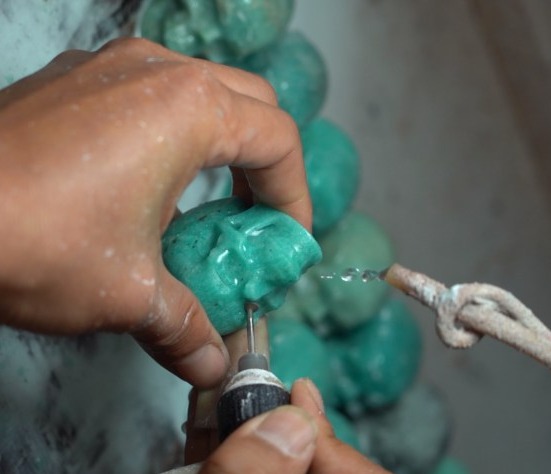
En achetant directement auprès de l'usine, vous évitez cet écueil. Vous avez visité leur atelier, approuvé des échantillons en personne et vous savez exactement ce que vous achetez.
3. Le problème « À qui est-ce que j’achète réellement ? »
Trouver un fournisseur sur Alibaba ne signifie pas automatiquement trouver un fabricant.Beaucoup d'annonces concernent des sociétés commerciales — des intermédiaires qui augmentent le prix des produits manufacturés et s'occupent des formalités d'exportation.
Un observateur du secteur le dit sans détour : « Alibaba reste imbattable en termes d’étendue de son offre et de prix directs d’usine pour les commandes en gros, mais perd en confiance envers les fournisseurs, en faibles quantités minimales et pour tout ce qui est personnalisé. »
Une relation directe signifie que vous savez qui taille votre pierre.
Quand Alibaba devient enfin logique
Soyons honnêtes. Alibaba n'est pas inutile. C'est l'outil idéal pour :
Premiers acheteurs qui ont besoin de la protection de l'assurance commerciale
petites commandes d'essai moins de 500 $ où la marge est négligeable
Découverte de produits — trouver des fournisseurs que vous pourriez ultérieurement transférer hors plateforme
Mais pour les commandes répétées ? Pour tout montant supérieur à 1 000 $ ? Le calcul change.
L'avantage de la vente directe d'usine
Une relation de quatre ans ne se construit pas du jour au lendemain. Mais tout commence par une commande. Un échantillon. Une conversation.
Offre directe des usines :
Aucune majoration de plateforme — vous payez le prix réel de la pierre
Qualité constante — le même sculpteur, les mêmes exigences, commande après commande
MOQ flexibles — parce que vous parlez à la personne qui prend les décisions
Communication plus rapide — pas d'intermédiaire, pas de délais de traduction
Cet utilisateur de r/Crystals qui est fidèle au même fournisseur depuis quatre ans ? Il n'a pas de chance. Il ne paie tout simplement pas pour une plateforme dont il n'a pas besoin.
En résumé
Une commande de 3 000 $ sur Alibaba peut vous coûter 3 300 $ à la livraison. La même commande, passée directement auprès d'une usine de confiance, coûte moins cher. 3 000 $.
La différence ne réside pas dans la pierre, mais dans le canal.
Si c'est votre premier achat, la protection d'Alibaba justifie son prix. Mais si vous passez des commandes régulières ? Trouvez un fabricant. Établissez une relation de confiance. Arrêtez de payer un intermédiaire inutile.
Le marché du cristal devrait atteindre 13,6 milliards de dollars d'ici 2035La question n'est pas de savoir s'il y a une demande. Il s'agit de savoir si votre marge survit aux frais de la plateforme.


 English
 Français
 عربي
عربي Deutsch